
Lab Rig Model
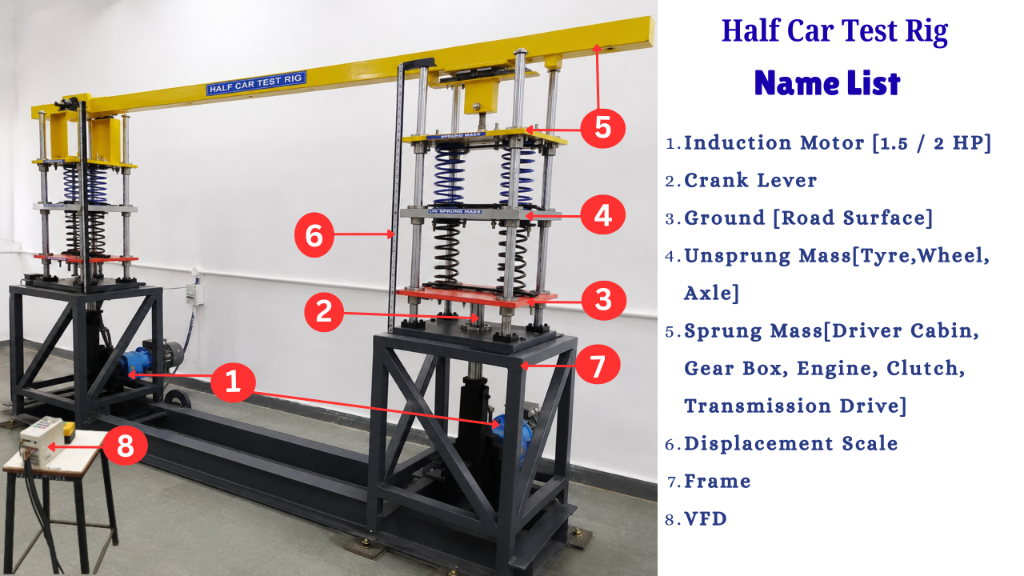
Half-Car Vibration Test Rig
Demonstrating the dynamic behavior of a vehicle's front and rear suspension systems.
track_changes Purpose
The Half-Car Vibration Test Rig simulates vehicle suspension behavior under different road conditions.
science Experimental Procedure
1. Preparation
- Inspect the test rig and ensure all mechanical components are securely fastened.
- Check the condition of springs, dampers, tires (or tire simulators), and slider mechanisms.
- Calibrate all accelerometers and displacement sensors.
- Connect sensors to the DAQ system and verify signal quality.
2. Test Setup
- Mount the sprung mass (vehicle body) on the front and rear suspension assemblies.
- Ensure the unsprung masses are properly connected to the excitation platform.
- Attach accelerometers to:
- Vehicle body (sprung mass)
- Front wheel assembly
- Rear wheel assembly
- Base/excitation platform (optional)
- Connect the vibration exciter or road profile simulator to the control system.
3. Conducting the Test
- Switch on the data acquisition system.
- Apply a low-amplitude sinusoidal excitation.
- Gradually increase the excitation frequency over the desired range (for example, 1–20 Hz).
- Record acceleration and displacement responses at each frequency.
- Identify resonance frequencies from the measured response.
- Repeat the experiment for different:
- Suspension stiffness
- Damping settings
- Vehicle loading conditions (if applicable)
- Save all recorded data after each test.
visibility Observations
Record:
- Excitation frequency (Hz)
- Input displacement or acceleration
- Sprung mass acceleration
- Front unsprung mass acceleration
- Rear unsprung mass acceleration
- Suspension deflection
- Resonance frequency
- Peak vibration amplitude
school Learning Outcomes
- Understanding vehicle dynamics.
- Studying spring and damper performance.
- Measuring vibration transmission from wheels to vehicle body.
- Evaluating ride comfort and vehicle stability.
engineering Engineering Applications
Automobile suspension design
Vehicle ride comfort analysis
Chassis development
Automotive NVH optimization
stars Benefits
Students learn how suspension systems reduce vibrations, improve passenger comfort, and enhance vehicle safety through effective vibration isolation.