
Lab Rig Model
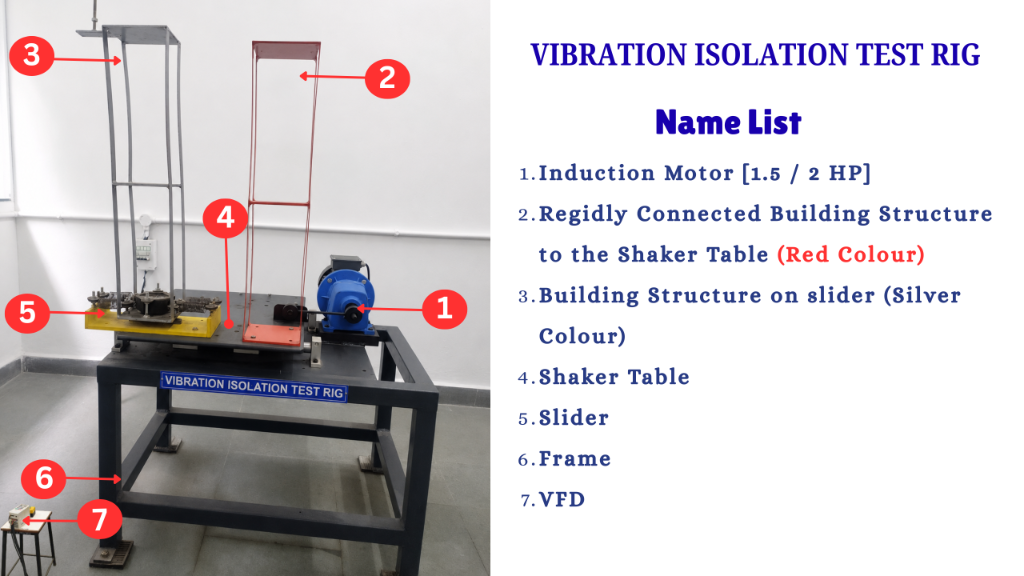
Vibration Isolation Model / Shaker Table
Demonstrating how base isolation systems protect structures from seismic vibrations.
track_changes Purpose
The Earthquake Isolation Model demonstrates how base isolation systems protect buildings from seismic vibrations.
science Experimental Procedure
- Check that all bolts and fixtures are tightened.
- Set the excitation parameters (frequency range and amplitude).
- Start the vibration exciter at a low amplitude.
- Increase the excitation gradually while monitoring system response.
- Perform either:
- Frequency sweep (e.g., 1�50 Hz), or
- Fixed-frequency tests at selected frequencies.
- Record acceleration, displacement, and vibration amplitude for both structures.
- Repeat the test for different isolator configurations (if applicable).
- Stop the excitation and save all recorded data.
visibility Observations
- Input excitation frequency
- Input acceleration
- Response acceleration of the fixed structure
- Response acceleration of the slider-mounted structure
- Relative displacement of the slider
- Resonance frequency
- Peak vibration amplitude
school Learning Outcomes
- Understanding earthquake-induced vibrations.
- Studying the effectiveness of rubber pads and sliding isolators.
- Analyzing vibration transmission between ground and structure.
- Learning structural safety and earthquake-resistant design principles.
engineering Engineering Applications
High-rise
buildings
Hospitals
and emergency facilities
Bridges
and infrastructure
Earthquake-prone
regions
stars Benefits
By observing the isolated and non-isolated structures, students gain practical knowledge of how vibration isolation significantly reduces structural damage during seismic events.