
Lab Rig Model
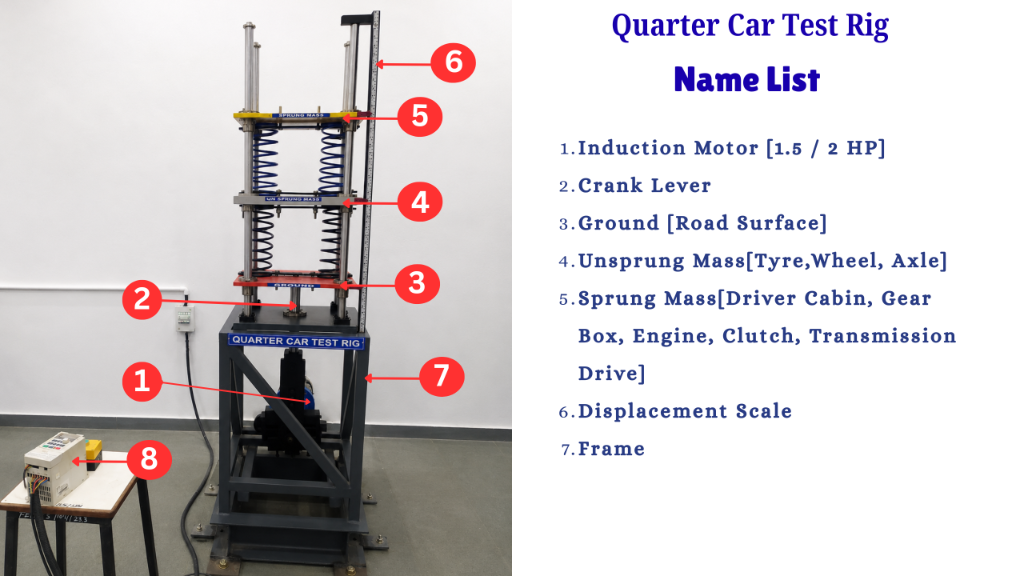
Quarter Car Testrig
Demonstrating the fundamental principles of vehicle suspension dynamics.
track_changes Purpose
The Quarter-Car Vibration Test Rig simulates vehicle suspension behavior under different road conditions.
science Experimental Procedure
1. Preparation
- Inspect the test rig and ensure all mechanical components are securely fastened.
- Check the condition of springs, dampers, tires (or tire simulators), and slider mechanisms.
- Calibrate all accelerometers and displacement sensors.
- Connect sensors to the DAQ system and verify signal quality.
2. Test Setup
- Mount the sprung mass (vehicle body) on the front and rear suspension assemblies.
- Ensure the unsprung masses are properly connected to the excitation platform.
- Attach accelerometers to:
- Vehicle body (sprung mass)
- Front wheel assembly
- Rear wheel assembly
- Base/excitation platform (optional)
- Connect the vibration exciter or road profile simulator to the control system.
3. Conducting the Test
- Switch on the data acquisition system.
- Apply a low-amplitude sinusoidal excitation.
- Gradually increase the excitation frequency over the desired range (for example, 1-20 Hz).
- Record acceleration and displacement responses at each frequency.
- Identify resonance frequencies from the measured response.
- Repeat the experiment for different:
- Suspension stiffness
- Damping settings
- Vehicle loading conditions (if applicable)
- Save all recorded data after each test.
visibility Observations
Record:
- Excitation frequency (Hz)
- Input displacement or acceleration
- Sprung mass acceleration
- Front unsprung mass acceleration
- Rear unsprung mass acceleration
- Suspension deflection
- Resonance frequency
- Peak vibration amplitude